

News
FeCrAl Wire vs Nichrome Wire: Which Is Better for Industrial Heating?

FeCrAl and nichrome are two widely used resistance-alloy families for electric heating. Both convert electrical energy into heat effectively and can be manufactured into wire, ribbon and formed heating elements. However, they differ in temperature capability, electrical resistivity, oxidation behaviour and mechanical characteristics.
For industrial buyers comparing materials through a FeCrAl Wire Supplier, neither alloy should automatically be considered better. The right choice depends on furnace temperature, atmosphere, element geometry, resistance requirements and the mechanical demands placed on the heater.
What Is FeCrAl Wire?
FeCrAl stands for iron-chromium-aluminium. It is a ferritic resistance-alloy family used extensively in industrial electric heating. Kanthal's FeCrAl range includes materials such as Kanthal® APM, A-1, AF and D, with current materials specified for maximum continuous operating temperatures ranging up to 1,425°C depending on grade.
At elevated temperatures, FeCrAl alloys develop an aluminium-oxide protective layer, contributing to their strong oxidation resistance in suitable operating environments, a mechanism covered in more depth in our APM materials guidance.
What Is Nichrome Wire?
Nichrome generally refers to nickel-chromium, or NiCr, resistance alloys. These materials are austenitic rather than ferritic and are also widely used for electric heating. Kanthal markets its NiCr alloys under the Nikrothal® name, with grades designed for both industrial furnaces and electrical appliances.
Nichrome is particularly valued for good workability, ductility and high-temperature mechanical strength. These properties can make NiCr attractive where heating elements require significant forming, welding or mechanical stability.
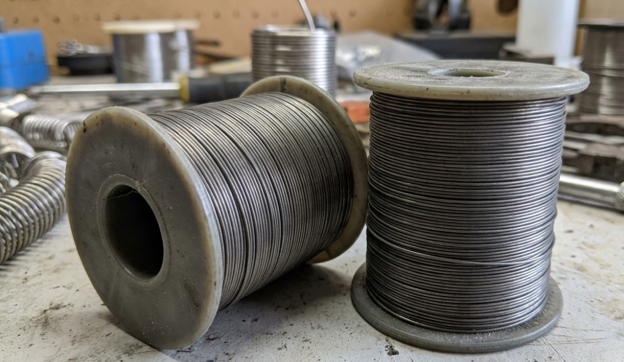
Compare Maximum Temperature
For demanding high-temperature furnace applications, certain FeCrAl grades provide a clear temperature advantage. Within Kanthal's current range, Kanthal® APM FeCrAl is rated up to 1,425°C and Kanthal® A-1 FeCrAl up to 1,400°C, while Nikrothal® 70 NiCr is rated up to 1,250°C and Nikrothal® 80 NiCr up to 1,200°C.
These are maximum continuous operating temperatures for the specific branded materials and should not automatically be applied to generic FeCrAl or nichrome products from other manufacturers. For furnaces approaching the upper operating range of metallic elements, FeCrAl may therefore provide greater design flexibility.
Electrical Resistivity Matters
FeCrAl typically offers higher electrical resistivity than common NiCr heating alloys. For example, Kanthal® A-1 has a room-temperature resistivity of 1.45 ? mm²/m, while Nikrothal® 80 is listed at 1.09 ? mm²/m.
Higher resistivity can influence the conductor length and wire diameter required to achieve a particular element resistance. This means FeCrAl and nichrome cannot simply be exchanged while keeping the same wire dimensions; whenever the alloy changes, engineers should recalculate resistance, conductor length, surface loading and power.
FeCrAl Can Reduce Element Weight
Density also differs between the two alloy families. Kanthal's published furnace data lists a density of about 7.10 g/cm³ for APM and A-1 compared with approximately 8.3 g/cm³ for Nikrothal® 80.
Combined with higher resistivity, the lower density can reduce the amount of element material required in some designs. Kanthal provides one furnace-element comparison in which switching from a NiCr design to FeCrAl produced an approximately 33% reduction in element weight. This is an example for a particular design, not a universal saving.
Compare Oxidation Resistance
Oxidation behaviour is particularly important in furnaces operating for long periods at high temperature. FeCrAl forms a protective aluminium-oxide scale, while NiCr relies primarily on chromium oxide; Kanthal identifies the alumina layer as one of the reasons its FeCrAl materials perform particularly well in high-temperature oxidising conditions.
Actual element life still depends on more than alloy choice, and the factors affecting resistance-wire durability are covered in our failure-prevention guidance.
Where Nichrome Has Advantages
Nichrome should not be viewed simply as a lower-temperature alternative. NiCr alloys generally provide excellent ductility and good high-temperature mechanical strength, which Kanthal specifically highlights for applications where workability and mechanical performance are important.
This can make nichrome attractive for tubular heating elements, complex formed heaters, components requiring substantial welding, applications involving tight bending, and designs requiring strong hot mechanical properties. The correct choice therefore depends on how the element is manufactured as well as how hot it operates.
When FeCrAl May Be Better
FeCrAl is often worth considering when very high element temperatures are required, high electrical resistivity benefits the design, oxidation resistance is a major concern, reduced element material weight is desirable, or long furnace operating cycles are expected. Kanthal specifically uses FeCrAl metallic elements across industries including steel, aluminium and heat treatment.
When Nichrome May Be Better
NiCr may make more sense when formability is particularly important, the element requires extensive fabrication or welding, high hot strength is a priority, operating temperature remains comfortably within the NiCr grade's rating, or an existing heater has already been designed and validated around nichrome.
Changing an established NiCr design to FeCrAl purely because FeCrAl has a higher maximum temperature can create unnecessary redesign work.
Conclusion
FeCrAl and nichrome both remain valuable industrial resistance-heating materials, but they offer different strengths. FeCrAl generally provides higher resistivity, lower density, strong oxidation resistance and higher maximum operating temperatures in comparable Kanthal product ranges. Nichrome offers excellent workability, ductility and mechanical performance, making it well suited to many formed and fabricated heating elements.
The best material should therefore be selected from the complete heating-system requirements. Furnace temperature, atmosphere, wire diameter, resistance, surface loading and element geometry should all be evaluated before choosing or substituting either alloy.