

News
How to Select a Kanthal Heating Element Supplier for High-Temperature Furnaces

Heating elements are among the most critical components in an industrial furnace. Their material, dimensions and electrical characteristics affect heat-up performance, temperature stability, energy use and maintenance intervals. For facilities operating at elevated temperatures, choosing the right supplier involves much more than comparing prices or alloy names on a spec sheet.
This article focuses on the engineering and manufacturing capability that separates a wire seller from a heating-element supplier: the part of the evaluation that matters once the alloy grade itself has already been confirmed.
Start With the Operating Conditions
The first step is defining how the furnace will operate. A supplier should ask about furnace temperature, required power, available voltage, chamber dimensions, atmosphere and the material being processed. These are the fundamental inputs for determining the dimensions and form of an industrial heating element.
A supplier that recommends an element without asking about these conditions may not have enough information to make an appropriate selection, regardless of how well they know the alloy itself.
Evaluate Element Design Capability
Buying resistance wire and buying a finished furnace element are different tasks. A good supplier should understand how wire diameter, coil diameter, pitch, surface loading, supports and terminal design interact. Poorly designed elements can experience uneven heating or mechanical problems even when the alloy itself is entirely suitable.
Surface loading, the power dissipated per unit of element surface area, is one of the more overlooked design variables. An element that is electrically correct but loaded too heavily for its surface area and the surrounding atmosphere will run hotter locally than the calculation suggests, shortening its service life.
Ask whether the supplier can produce different configurations, such as:
- Helical coils
- Straight or corrugated elements
- Suspended elements
- Ceramic-supported designs
- Custom terminal arrangements
- Elements manufactured from wire or strip
The appropriate geometry depends on the furnace construction and available installation space, and a supplier limited to one or two standard forms may not be a good fit for a non-standard furnace.
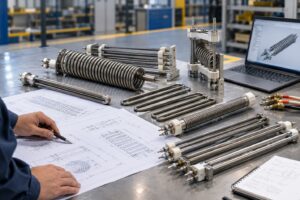
Look at How Terminals and Supports Are Engineered
The cold end of a heating element, where the resistance wire transitions to a terminal connection, is a common failure point that gets far less attention than the resistance alloy itself.
Ask how the supplier handles the transition between the heating section and the terminal: whether cold-end wire or an alternative low-resistance material is used, how the joint is made, and how it is supported against vibration and thermal expansion during cycling.
Element supports deserve the same scrutiny. Ceramic supports, insulator spacing and mounting hardware all affect how much movement the element can accommodate as it expands and contracts, and how much extra length or slack should be designed in to avoid stressing the wire or the joint.
Ask How Finished Elements Are Tested Before Shipment
Testing raw wire is not the same as testing a finished element, and buyers should ask about both. A completed element should be checked for continuity, measured resistance against the design value, and dimensional accuracy of the coil, including pitch, outside diameter and overall length, before it leaves the factory.
For repeat orders, ask whether the supplier retains the test records against a drawing or specification number, so a replacement element ordered a year later can be verified against the same criteria as the original.
Consider Customisation and Lead Time for Replacement Elements
Industrial furnaces are often maintained for many years, and original heating elements may no longer be readily available. A supplier capable of working from drawings, samples or verified furnace specifications can be valuable when replacements are required.
Custom manufacturing should not mean uncontrolled variation, though. Confirm tolerances, materials, resistance values, quantities and expected lead times before production begins. For critical equipment, some companies choose to hold spare elements in stock so that a single failure does not create unnecessary downtime.
Weigh Engineering Support Against Price
The cheapest heating element is not necessarily the lowest-cost option over the life of a furnace. A supplier who asks detailed questions about operating conditions, offers multiple element configurations and tests finished elements before shipment is doing engineering work that a bare wire quotation does not reflect, and that work is usually what prevents the unplanned shutdowns that cost far more than the price difference on the invoice.
Conclusion
Selecting a Kanthal heating element supplier is ultimately an engineering evaluation, not just a purchasing one. Once the alloy grade itself is confirmed, the questions that matter most are about element design capability, terminal and support engineering, and how finished elements are tested, rather than a repeat of alloy specifications already covered on the datasheet.
A supplier that treats element manufacturing as an engineering discipline, rather than simply cutting and coiling wire to a stated diameter, is better positioned to deliver elements that hold up under real furnace conditions over repeated replacement cycles.