

News
Kanthal APM Wire High-Temperature Performance: What Buyers Need to Know

High-temperature furnace applications place severe demands on resistance heating elements. As element temperature rises, oxidation, dimensional change, contamination and mechanical loading become increasingly important considerations.
Kanthal APM is designed for demanding high-temperature resistance-heating applications, but buyers should understand what makes the material different before specifying it for a furnace project or purchasing it in volume. A qualified Kanthal APM wire high temperature supplier should be able to speak to these structural details directly, rather than pointing only to the datasheet's temperature rating. This article focuses specifically on APM's underlying metallurgy and how that structure translates into real furnace performance, rather than repeating general supplier-selection or purchasing checklists.
What Is Kanthal APM?
Kanthal APM is a ferritic iron-chromium-aluminium alloy manufactured using powder-metallurgical techniques and dispersion strengthening, rather than conventional melting and casting.
According to Kanthal's current wire datasheet, the alloy is intended for temperatures up to 1425°C and is characterised by high-temperature form stability and oxidation resistance.
It is used in applications including industrial heat-treatment furnaces, ceramic firing, laboratory furnaces, electronic-industry furnaces and diffusion furnaces. The powder-metallurgical route is what separates APM from conventional FeCrAl wire, and it is the reason the rest of this article focuses on structure rather than the temperature figure alone.
How the Powder-Metallurgical Structure Affects Fabrication
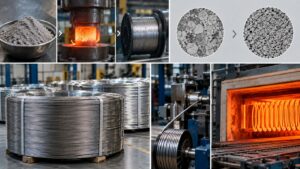
Conventional FeCrAl alloys are melted, cast and drawn into wire, producing a relatively coarse grain structure that can coarsen further at high temperature. APM is produced from metal powder that is consolidated and processed to create a fine, dispersion-strengthened microstructure, which is what gives the alloy its resistance to grain growth and creep at elevated temperature.
This has practical implications for element manufacturers, not just furnace operators. Because the microstructure behaves differently from standard wire, coil-winding parameters, minimum bend radii and hot-forming temperatures used for conventional Kanthal grades should not automatically be assumed to transfer to APM without confirmation from the supplier or the alloy's processing guidance.
Buyers purchasing APM to manufacture their own elements, rather than buying finished elements, should ask specifically whether their existing winding and forming process has been validated for this alloy.
Form Stability Matters at High Temperature
A heating element must do more than become hot; it also needs to hold an acceptable geometry while operating. As metallic materials operate at high temperature, mechanical strength and dimensional stability become important. Excessive deformation, sagging or coil elongation can affect element spacing, supports and the relationship between the element and surrounding furnace components.
Kanthal highlights form stability as one of APM's defining characteristics and notes that it can reduce the amount of element support required in suitable designs. For furnace engineers, that property can matter as much as the headline temperature rating: fewer supports can mean simpler element geometry and, in some designs, more usable furnace chamber volume.
Oxide Formation Protects the Surface
FeCrAl resistance alloys, including APM, are valued in part because they develop an aluminium-rich protective oxide layer when exposed to high temperature. Maintaining a dense, continuous oxide layer is important to element durability.
That layer can be compromised by thermal cycling severe enough to cause the oxide to crack or flake away from the metal surface, exposing fresh alloy to renewed oxidation each time the cycle repeats. Kanthal's furnace guidance explains that element life depends on maintaining a protective oxide layer and notes that contaminants in the furnace atmosphere can damage heating elements.
This means purchasing a high-performance alloy does not eliminate the need for proper furnace operation. Oil, dust, process deposits and other contaminants should still be controlled, and elements exposed to frequent rapid cycling should be assessed with this oxide-stability trade-off in mind.
Maximum Temperature Is Not the Normal Operating Target
A common purchasing mistake is treating the published maximum continuous temperature as a recommended operating target. A material rated to a certain maximum does not mean every element should be designed to run continuously at that value.
Element surface load, wire diameter, atmosphere, cycling pattern and required service life should all be considered. Kanthal's technical guidance specifically identifies temperature, cycling, contamination, diameter, atmosphere, mechanical stress and regulation method as variables influencing wire life. Engineering calculations, not the datasheet maximum alone, should determine the actual operating point for an APM element.
When Standard Kanthal A-1 Is Enough, and When APM Earns Its Premium
APM carries a cost premium over conventional FeCrAl grades, so it is worth being clear about when that premium is justified.
APM tends to earn its cost where furnaces run close to the top of the standard-alloy temperature range, where element sag or support failure has been a recurring maintenance issue, or where reduced support requirements meaningfully simplify a furnace rebuild.
Where a furnace consistently operates well below the maximum rating of a conventional grade, and support-related failures have not been a problem, the case for specifying APM is weaker; the added cost may not translate into a measurable reliability gain for that specific application. This decision sits with the furnace engineer, and it should be made before requesting quotations rather than after.
Conclusion
Kanthal APM is a specialised high-temperature FeCrAl resistance heating alloy distinguished by its powder-metallurgical structure, oxidation behaviour and high-temperature form stability. Its published capability of up to 1425°C makes it relevant to demanding furnace applications, but that number is only useful once it is understood alongside how the alloy actually behaves: its microstructure, its oxide layer, and the operating conditions it will actually see.
Buyers evaluating APM should weigh these structural characteristics against their specific furnace conditions, rather than treating APM as a drop-in upgrade for every high-temperature application.