

News
Kanthal APM Wire Replacement: What Industrial Furnace Operators Should Know

Heating elements in high-temperature industrial furnaces operate under demanding thermal and mechanical conditions. When an element eventually needs replacement, the general engineering checklist, matching resistivity, temperature rating, wire diameter and furnace atmosphere, is the same one that applies to any FeCrAl replacement and is covered in full in our A-1 replacement guidance.
This article focuses on what's different about replacing Kanthal APM specifically: because APM is produced by a powder-metallurgical route rather than conventional melting and casting, the property that most often gets overlooked in a replacement decision isn't on the headline datasheet comparison at all.
What Is Kanthal APM?
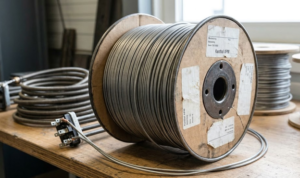
Kanthal® APM is a powder-metallurgical, dispersion-strengthened ferritic iron-chromium-aluminium alloy. According to the manufacturer's current technical data, it is designed for applications at temperatures up to 1,425°C in air and has an electrical resistivity of 1.45 ? mm²/m at 20°C, with typical applications including high-temperature furnaces used for ceramics, heat treatment, laboratory processes, electronics and diffusion operations.
The powder-metallurgical route and dispersion strengthening are what the rest of this article is about, because they are what APM's replacement candidates most often fail to actually reproduce, even when their resistivity and temperature rating look identical on paper.
Why Resistivity and Temperature Rating Aren't the Hard Part Here
For a conventional cast-and-drawn FeCrAl alloy like A-1, matching resistivity and temperature rating goes most of the way toward confirming a replacement will behave the same way, because the material's mechanical behaviour at temperature is reasonably predictable from its composition. APM is different: its defining advantage over conventional FeCrAl isn't primarily electrical, it's structural. A generic FeCrAl wire can match APM's resistivity and even its published maximum temperature while still behaving quite differently once it has spent hundreds of hours at that temperature.
This is why a replacement comparison built only around the numbers that appear on a standard datasheet, resistivity, temperature rating, diameter, systematically understates the risk of substituting a conventional alloy for APM.
The Property That Actually Matters: Creep Resistance and Form Stability
Two materials can have similar room-temperature resistivity yet behave very differently after hundreds of hours at high temperature. Kanthal describes APM as having particularly good high-temperature form stability and provides creep-strength data for elevated-temperature service, specifically because conventional alloys are more prone to sagging, stretching or creeping out of position under sustained heat and their own weight.
This is especially relevant in large coils or elements that are partially unsupported, where the alloy itself is what's keeping the element in its intended geometry rather than a dense arrangement of supports. If a replacement alloy has lower creep resistance, a coil can gradually deform even while its electrical performance still measures correctly, which makes this a failure mode that resistance testing alone will not catch.
What to Actually Ask a Substitute Supplier
Because creep and form-stability data is far less commonly published than resistivity or temperature rating, getting a genuine answer here usually requires asking for it directly rather than expecting it on a standard datasheet. Useful questions include whether the supplier has creep-strength or elongation-under-load data at the furnace's actual operating temperature, whether the material has a documented track record in similarly unsupported or long-span coil designs, and whether it uses a comparable strengthening mechanism to APM's dispersion-strengthened structure, or relies on conventional solid-solution strengthening instead.
A supplier that cannot answer these questions, or that responds only with resistivity and temperature-rating figures, has not actually demonstrated that their material will hold its shape the way APM does.
When This Matters Less
Not every APM replacement decision needs to weigh creep resistance heavily. For short, well-supported coils, elements with generous support spacing, or furnaces that don't run continuously at temperatures near APM's upper range, a conventional FeCrAl alloy with matching resistivity and an adequate temperature margin may perform acceptably even without APM's structural advantages.
The structural property matters most specifically where the original design was depending on it: long spans, reduced support counts, or continuous operation near the top of the alloy's rated range.
Covering the Rest of the Checklist
None of this removes the need to also check the items that apply to any FeCrAl replacement: resistivity and the recalculated element dimensions it implies, actual element temperature versus the furnace setpoint, atmosphere compatibility, and wire diameter and tolerance. These are covered in detail in our general replacement-equivalence guidance and apply to APM exactly as they would to any other grade.
For demanding furnaces, testing a replacement material in a controlled section or a planned maintenance cycle, before converting an entire furnace, remains sensible regardless of how complete the paper comparison looks.
Conclusion
Replacing Kanthal APM wire carries one risk that replacing a conventional FeCrAl alloy generally doesn't: a substitute can match every figure on a standard datasheet and still fail to hold its shape over a long high-temperature run, because the property that makes APM suitable in demanding furnaces is structural, not primarily electrical.
Asking specifically about creep resistance and form stability, not just resistivity and temperature rating, is what actually tests whether a substitute can do APM's job.